
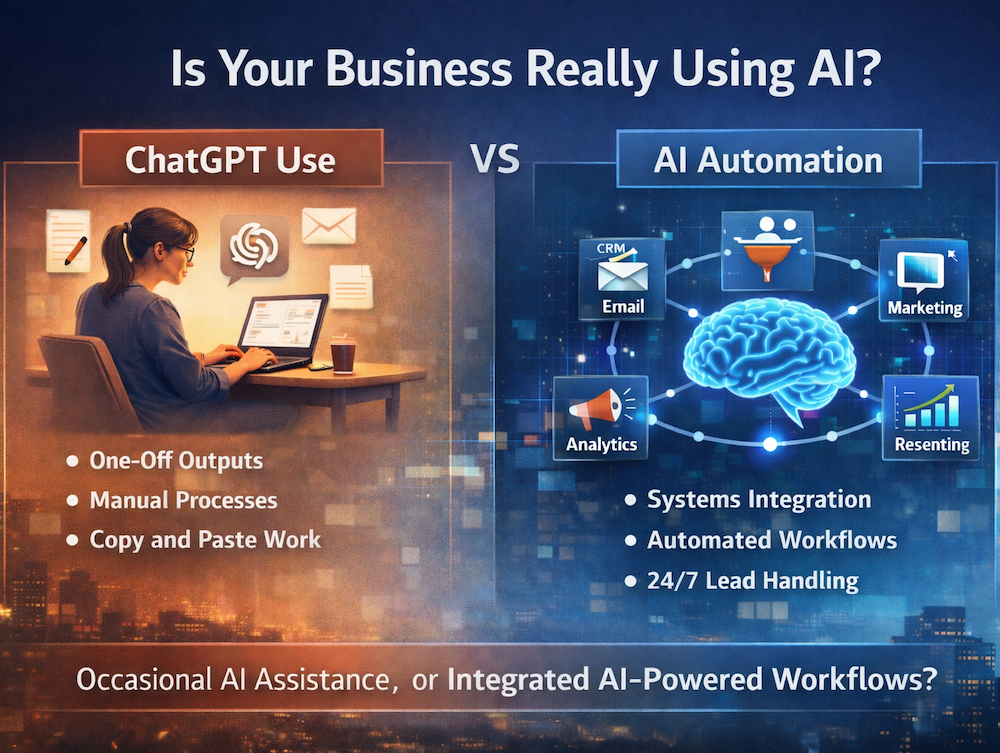
The difference between “using ChatGPT” and actually integrating AI into your business
AI in business, has quickly become one of the most talked-about topics in business. From startups to enterprise companies, everyone claims they are “using AI.”
But when you analyze how it’s actually being used, a clear gap appears:
“Most businesses are not leveraging AI as a system. They’re simply interacting with it as a tool.”
And that difference is what separates companies that experiment with AI from those that scale with it.
The Illusion of AI Adoption
Today, tools like ChatGPT have made AI incredibly accessible. To truly understand why most businesses are not fully leveraging AI, it’s important to recognize a fundamental distinction: the difference between using AI as a tool versus implementing it as a system. When businesses use tools like ChatGPT, they are typically engaging in isolated, manual interactions. A user writes a prompt, receives an output, and then decides what to do next. The process is entirely dependent on human input at every step. While this can improve speed and creativity, it does not eliminate workload or create consistency across operations. Each task still requires attention, repetition, and decision-making. In this sense, AI is simply acting as an assistant helpful, but not transformative.
You can:
- Generate content
- Brainstorm ideas
- Write emails
- Summarize documents
That means:
- The human is still doing the work
- AI is only supporting individual tasks
- Nothing fundamentally changes in the business structure
In contrast, a system operates with structure, continuity, and automation. When AI is integrated as part of a system, it no longer depends on constant human prompting. Instead, it becomes embedded within workflows, connected to other tools, and capable of executing tasks based on triggers and predefined logic. For example, instead of manually asking AI to rewrite a blog post for different platforms, a system would automatically detect when a new post is published, generate platform-specific versions, and distribute them accordingly without requiring additional input.
The key difference lies in how work flows. A tool supports individual actions, while a system manages entire processes. With a tool, you are still working inside your business; with a system, the business begins to work for you.
This distinction is where the real value of AI emerges. Businesses that remain at the “tool” level may experience incremental improvements, such as faster content creation or better communication. However, businesses that evolve into system-level integration unlock something far more powerful: scalability. Tasks are no longer repeated manually, errors are reduced, and operations become more predictable and efficient.
Ultimately, using AI as a tool is a starting point, but building it into a system is what creates long-term competitive advantage.
AI in Business: System Integration Across Your Tools
AI becomes exponentially more powerful when it is connected across the core systems that run your business. On its own, AI can generate content or answer questions but when integrated into your existing tools, it begins to create real operational impact. Instead of working in isolation, AI starts to move data, trigger actions, and connect processes automatically.
For example, your website can be connected to your CRM so that when a new lead fills out a form, their information is instantly captured, enriched, and even qualified using AI before it ever reaches your team. Platforms like HubSpot or Salesforce can integrate with AI to score leads, assign them to the right pipeline, and trigger personalized follow-ups without manual input.
Email systems are another key layer. Instead of manually responding to inquiries or sending campaigns, tools like Mailchimp or Klaviyo can leverage AI to personalize messaging, optimize send times, and automate entire communication flows based on user behavior. This turns email from a manual task into a dynamic, intelligent system.
Advertising platforms also benefit significantly from AI integration. By connecting your data to platforms like Google Ads or Meta Ads Manager, AI can analyze performance in real time, adjust targeting, and optimize campaigns based on actual results. Instead of guessing what works, your system continuously learns and improves.
Finally, analytics dashboards bring everything together. Tools like Google Analytics can integrate with AI to transform raw data into actionable insights highlighting trends, identifying issues, and even recommending next steps automatically.
When all these systems are connected, the business begins to operate as a unified ecosystem rather than a collection of separate tools. Information flows seamlessly, tasks are executed without constant oversight, and decisions are supported by real-time intelligence. This is where AI stops being just a feature and becomes a true operational advantage.
AI in Business: From Using AI to Running Your Business on AI
If your business is using ChatGPT, you’ve already taken an important first step into the world of AI, but it’s only the beginning. While generating content or ideas can improve speed, it doesn’t fundamentally change how your business operates. The real competitive advantage comes when AI moves beyond manual use and starts running in the background as part of your systems. This is where tools begin to communicate with each other automatically, workflows trigger without intervention, and repetitive tasks are handled without constant input. When that shift happens, your business no longer just uses AI, it starts operating on it.
If you’ve examined this information and find your business operations are primarily reliant on ChatGPT, and you’re looking for more robust solutions, the Zoomfer team is ready to help. Get in touch today for more details.